Overview
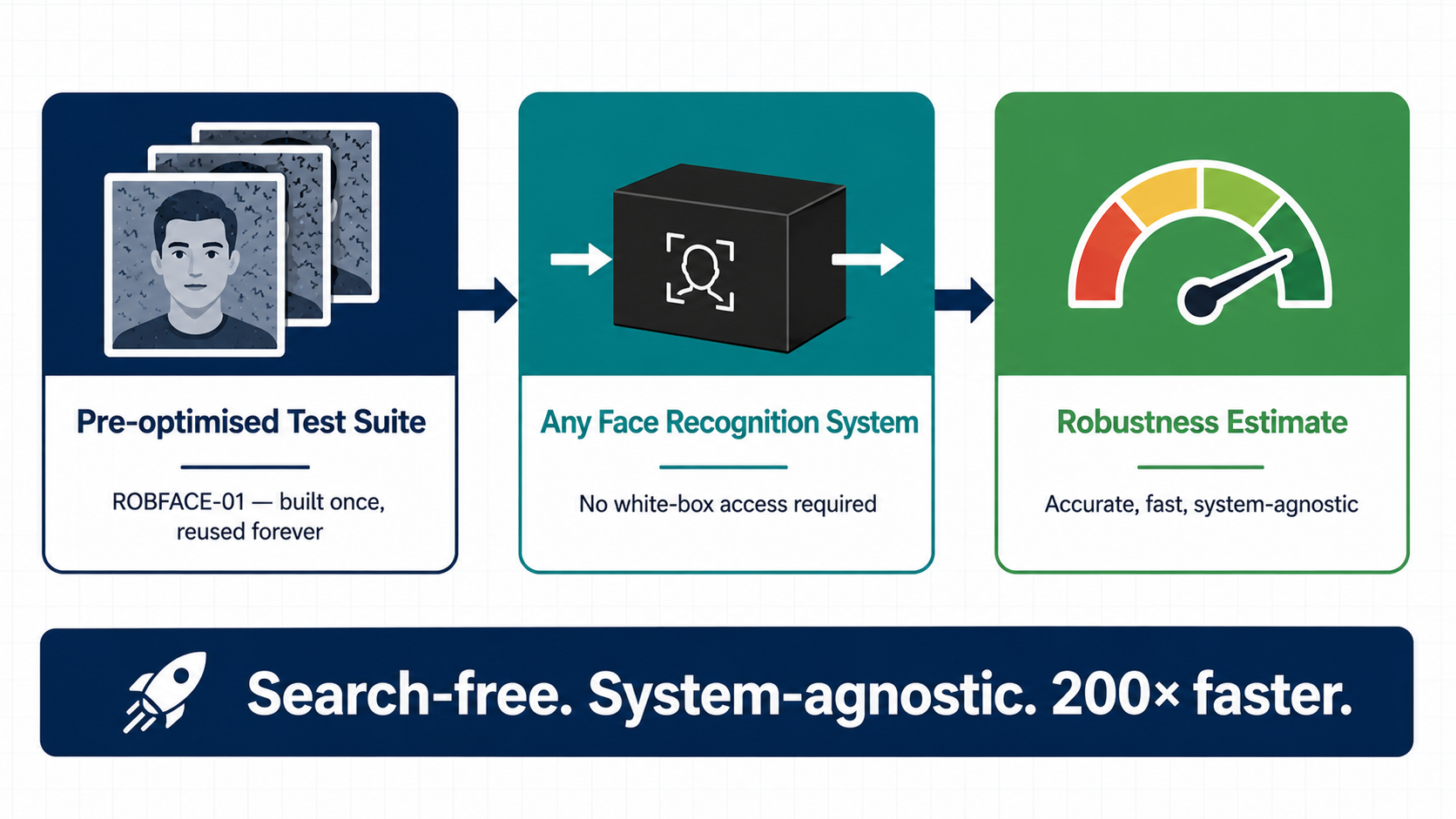
This work introduces ROBFACE, the first system-agnostic, search-free robustness evaluation method for face recognition systems.
Evaluating the robustness of a face recognition system is essential before deployment — and again after every update. Existing methods either require expensive iterative attacks or slow formal analysis, and most demand white-box access to the system under test. We ask:
Can we evaluate the robustness of any face recognition system efficiently, without white-box access and without running expensive searches at test time?
ROBFACE answers yes. It uses a pre-optimised test suite of transferable adversarial face images that can be run against any system in the same way traditional software is tested — simply execute the system on the test inputs.
Motivation
Face recognition systems are deployed in high-stakes settings — border control, payment authentication, access control. Their robustness against adversarial perturbations is critical. Yet evaluating that robustness is surprisingly hard.
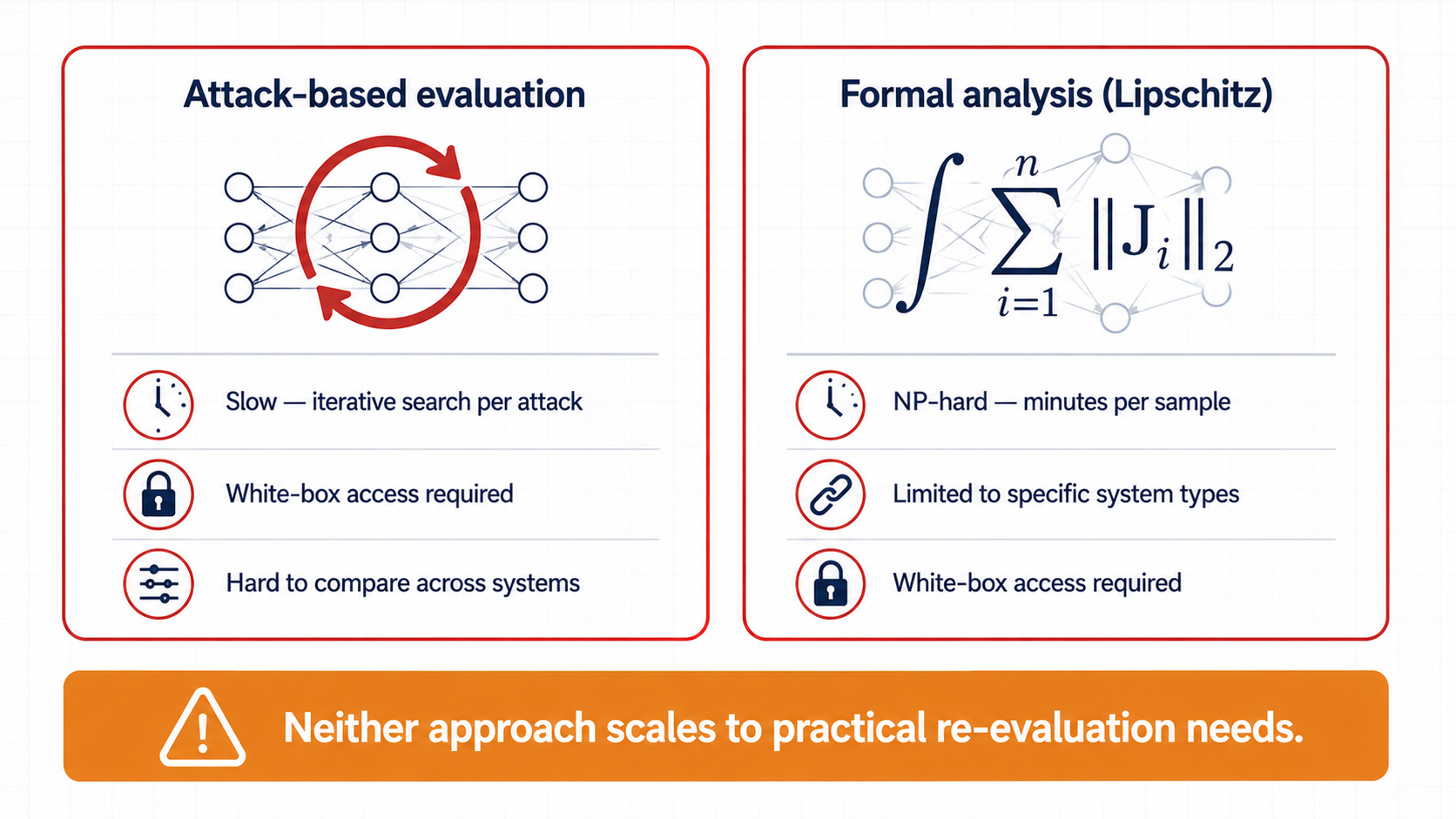
Two main approaches exist, each with serious limitations:
Empirical evaluation (attack-based): Run state-of-the-art adversarial attacks and measure success rate. This is intuitive but slow — each attack requires constrained iterative search — and requires white-box access to the model. Comparing different systems fairly is also difficult due to the variety of attack configurations.
Formal analysis (Lipschitz-based): Compute a theoretical robustness bound such as the Lipschitz constant. This provides guarantees but is even slower — finding the exact Lipschitz constant for a two-layer network is NP-hard — and applies only to limited system types.
Neither approach scales to the practical need of re-evaluating robustness every time a system is updated.
Key Idea: Test Suite for Robustness
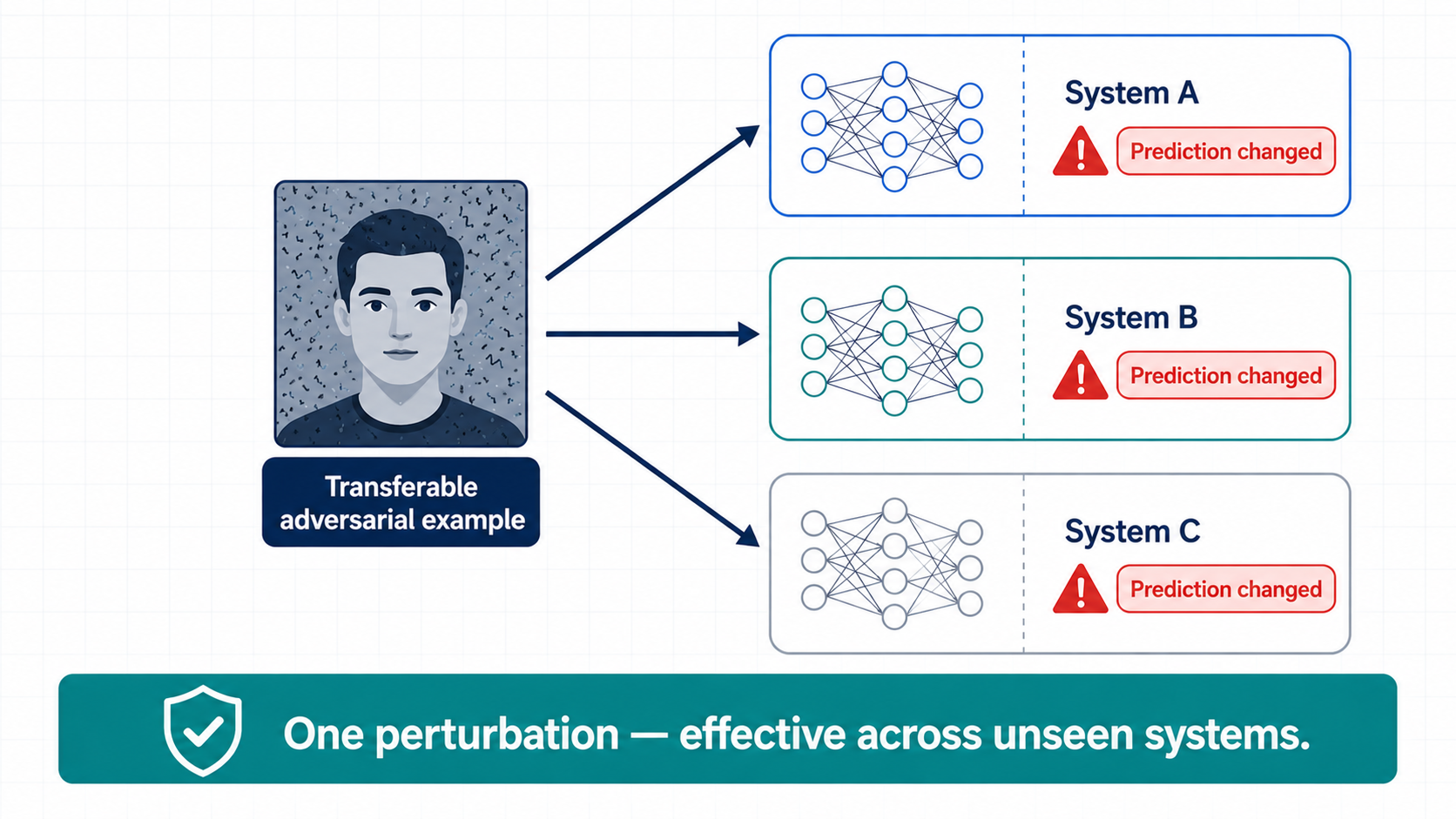
ROBFACE is built on a well-known but under-exploited property: adversarial transferability.
Adversarial perturbations crafted against one model often transfer to other models — they remain effective even on systems they were not designed for. This means a carefully curated set of adversarial examples can serve as a universal probe for robustness, without needing to attack each system from scratch.
The key insight is that if a test suite is pre-optimised to correlate with formal robustness measures across a diverse set of surrogate models, it can estimate the robustness of unseen systems accurately — with no iterative search at evaluation time.
Approach
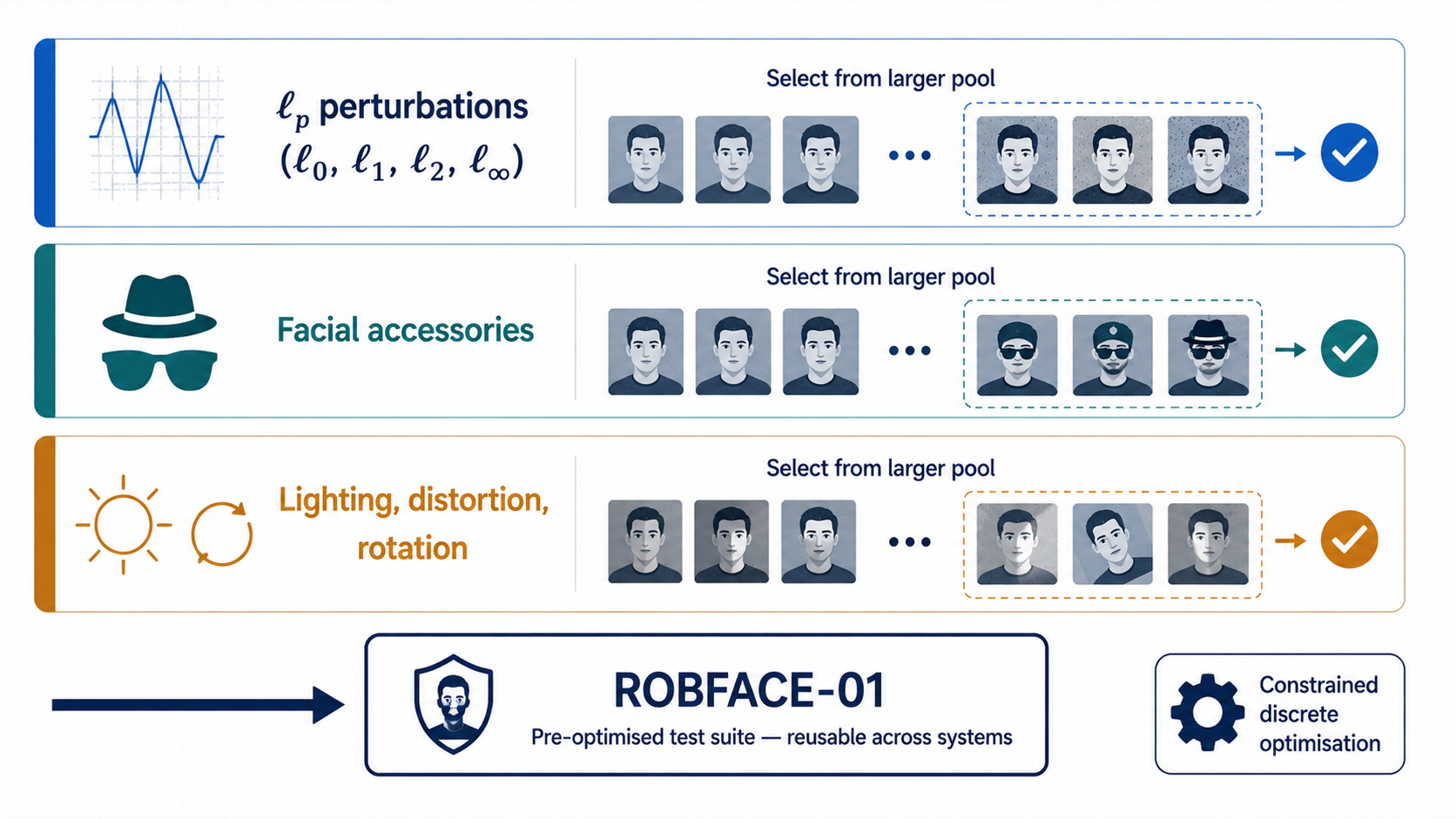
ROBFACE is constructed through a one-time offline optimisation process.
We collect transferable adversarial face images across multiple perturbation dimensions:
- ℓ_p-norm perturbations (ℓ_0, ℓ_1, ℓ_2, ℓ_∞)
- Facial accessories (glasses, hats, masks)
- Natural transformations (lighting, radial distortion, rotation)
For each perturbation type, we use constrained discrete optimisation to select a subset of adversarial examples whose aggregate evaluation result correlates strongly with both empirical attack-based evaluation and formal Lipschitz-based analysis on a set of surrogate systems.
The resulting test suite — ROBFACE-01 — is published and reusable. Evaluating any new system requires only a single forward pass over the test inputs. To prevent overfitting by system developers, ROBFACE also supports randomisation of the test suite via a secret random seed.
Results
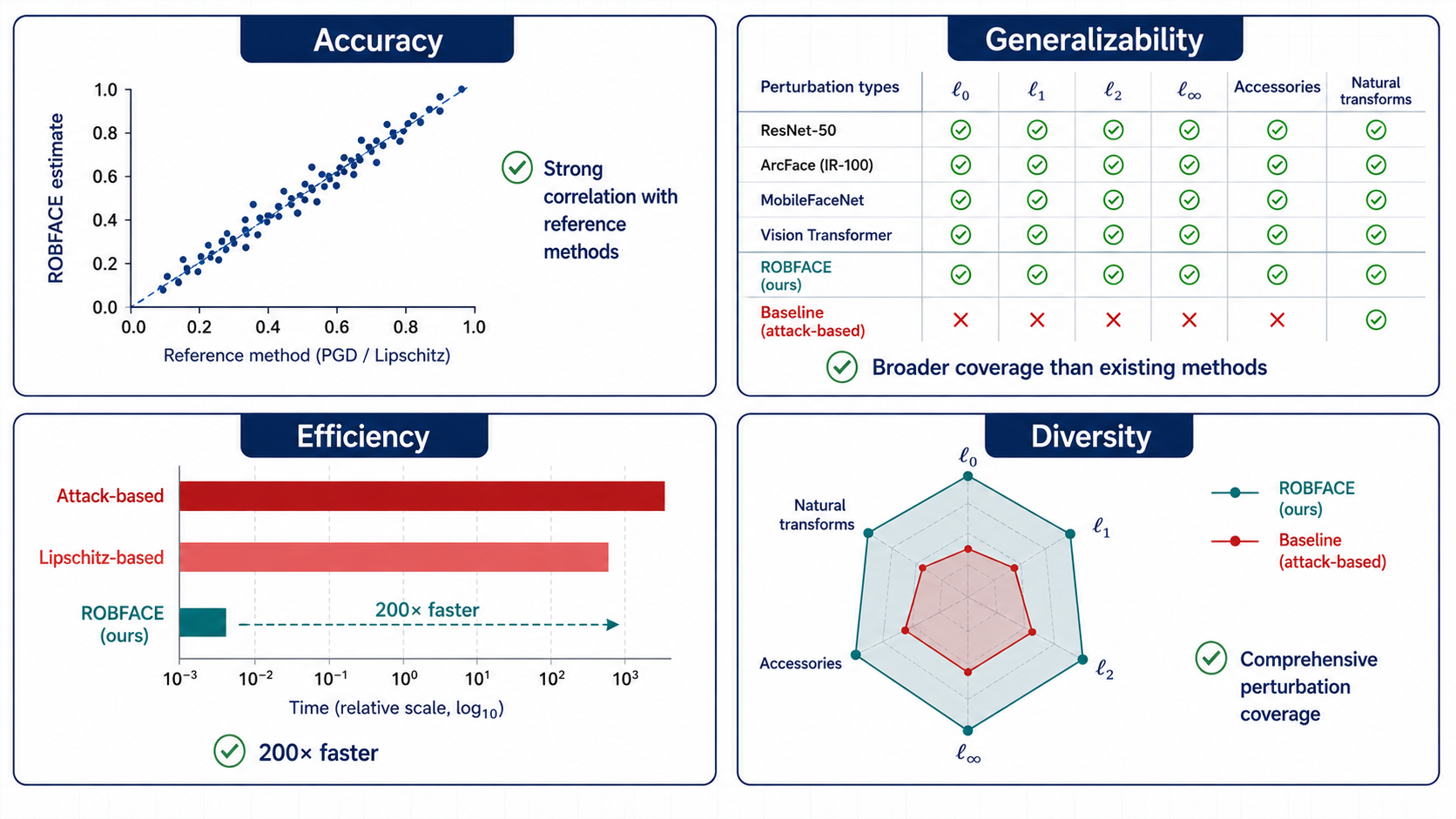
We evaluate ROBFACE along four dimensions against empirical (PGD-based) and formal (Lipschitz-based) reference methods.
Accuracy: ROBFACE estimates are strongly correlated with both empirical and formal robustness evaluation across all perturbation types.
Generalizability: ROBFACE transfers across different face recognition architectures and perturbation dimensions, where existing methods are often limited to specific systems or attack types.
Efficiency: ROBFACE accelerates robustness evaluation by more than 200× compared to existing approaches — eliminating iterative search entirely at test time.
Diversity: ROBFACE covers a comprehensive range of perturbation types, including both norm-bounded and realistic natural transformations.
Takeaway
Robustness evaluation does not have to be slow, system-specific, or white-box. A well-designed, pre-optimised test suite built on adversarial transferability can provide accurate, scalable, and system-agnostic robustness estimates for face recognition systems.
Takeaway:
ROBFACE brings old-school test suite methodology to deep learning robustness evaluation — system-agnostic, search-free, and 200× faster than existing approaches.
Citation
@article{zhang2025robface,
  author={Zhang, Ruihan and Sun, Jun},
  journal={IEEE Transactions on Reliability},
  title={RobFace: A Test Suite for Efficient Robustness Evaluation of Face Recognition Systems},
  year={2025},
  volume={74},
  number={3},
  pages={3615-3628},
  keywords={Face recognition;Robustness;Perturbation methods;Testing;Estimation;Accuracy;Optimization;Neural networks;Face recognition;robustness},
  doi={10.1109/TR.2025.3554575}
}